Virginia Aquarium & Marine Science Center
Introduction
One of my key accomplishments was upgrading the sensors of existing interactive exhibits and integrating them with Arduino-based control systems. This task required a detailed analysis of the original exhibit designs, as the existing hardware had specific spatial constraints.
To help younger audiences engage with marine science, I designed an interactive kit that illustrates the jellyfish life cycle and its movement mechanisms. This project showcases my ability to translate complex scientific concepts into accessible and engaging content, enhancing educational value through design thinking.
I designed and installed a remotely controllable camera system capable of rotating vertically and horizontally to observe animals in the aquarium. I also developed and installed an interactive exhibit that demonstrates the mechanism of a stingray’s tail sting.
Full-time employee
Keywords
Exhibit Technician II
My Skills
3D Printing
Industrial Design
Coding
New Exhibit - Stingray
An interactive stingray tail mechanism to visualize biological behavior through tactile engagement
Ideation
Next to the stingray aquarium, there is a small unused space. The supervisor would like to have an interactive exhibit demonstrating the stingray’s stinging motion. In the initial concept phase, there are two possible ways to animate the stingray’s tail: one is by using a string-pulling mechanism, and the other is through an inflatable structure.

3D Modeling & Test
I quickly built 3d models to visualize the concept. At this stage, the supervisor favored the inflatable approach. Therefore, I conducted pneumatic tests on the inflatable tail and made a mold of the stingray. However, since the model lacked sufficient detail and the silicone tail was difficult to control in terms of shape, this approach was ultimately not adopted.


Servo motor Pushing Idea
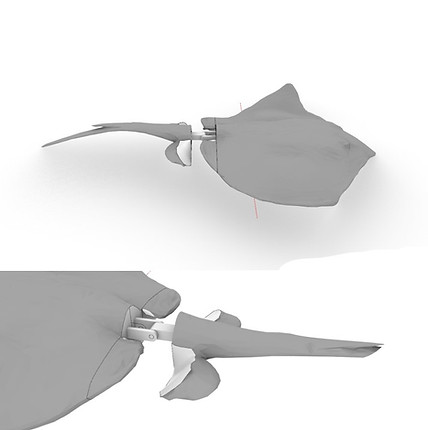
I was given an old model made of fiberglass. I cut its tail into two sections to study how it could move. Then, I came up with a structure using 3d printed connection structure (the hinge is too small to install), with a linear servo motor pushing from the base.

Final
I created the 3D model in Rhino, worked with the team to complete the exhibit installation, and independently handled the installation of the interactive components.

New Exhibit - Camera
A remote-controlled pan-tilt camera system for live animal observation using the RS-485 protocol to interface an ESP82 microcontroller with the camera hardware.
Design Process
The left side shows the first-generation design, which utilized dual servos for pan-tilt control. However, the assembly was too oversized. I subsequently switched to a camera with integrated pan-tilt capabilities and an RS485 port for microcontroller communication, as seen on the right.


The camera controller is made of wood. The joystick on the left controls pan and tilt, while the buttons on the right control zoom in and zoom out. Illuminated buttons were chosen to attract users’ attention and enhance their engagement.


New Exhibit - Coral Spawning
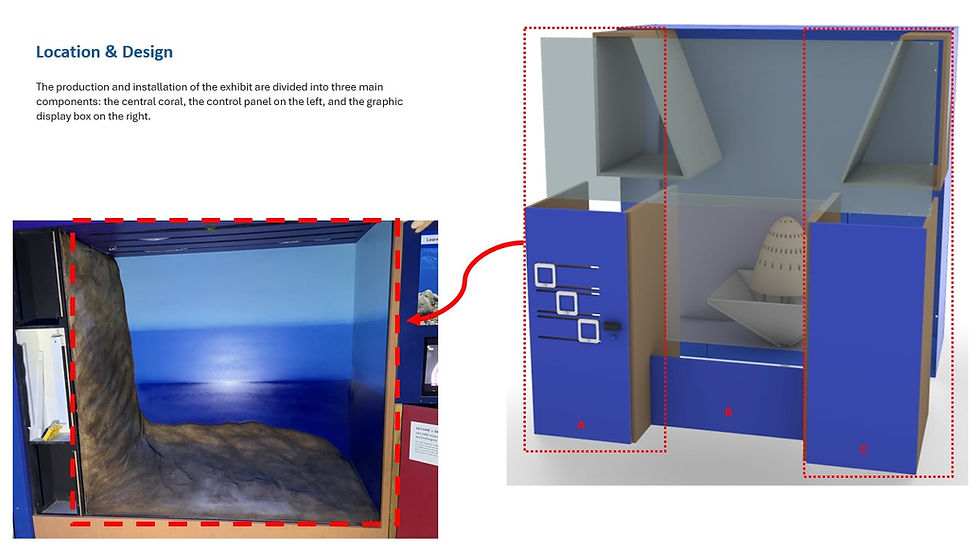
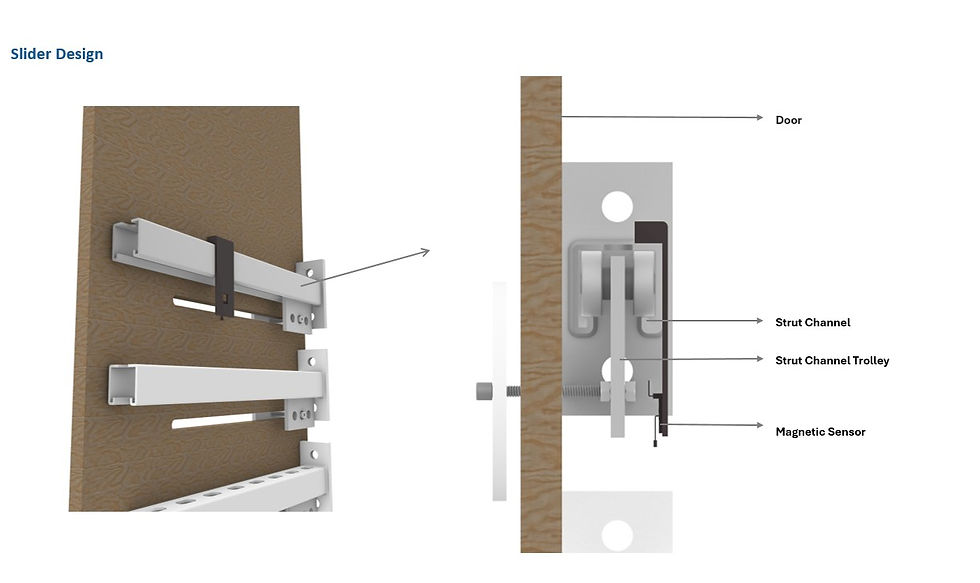
An in-house interactive exhibit simulating coral spawning, using an Arduino-controlled blower fan to mimic gamete release.
What is coral spawning?
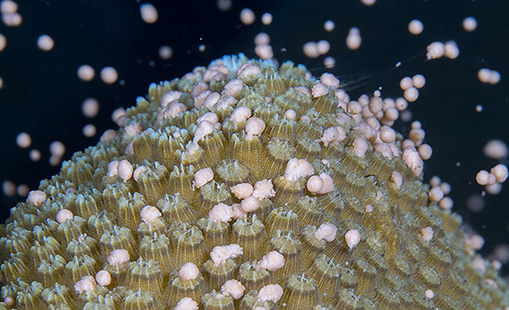
Coral spawning is the mass reproductive event when corals release their eggs and sperm into the water—often all at once—to reproduce sexually.





Last updated Aug. 21, 2026